|
2011 World Series presented some firsts
Hilo became first league to win two titles in Bangor; Friuli Venezia Giulia became first Europe-Middle East-Africa team to reach semifinals
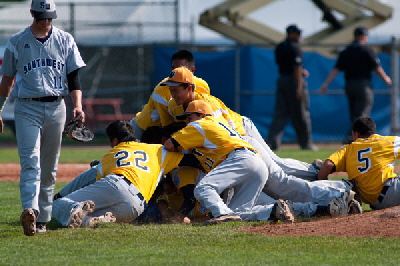 For only the second time in 10 Bangor World Series, two undefeated teams faced off for the world championship in 2011, as U.S. Southwest champ Rose Capital East L.L., Tyler, Texas, and U.S. West champ Hilo L.L., Hilo, Hawaii, were a perfect 4-0 in their respective pools. For only the second time in 10 Bangor World Series, two undefeated teams faced off for the world championship in 2011, as U.S. Southwest champ Rose Capital East L.L., Tyler, Texas, and U.S. West champ Hilo L.L., Hilo, Hawaii, were a perfect 4-0 in their respective pools.
Hilo came out on top, 11-1, in another first – a championship game ended early because of the 10-run rule.
With his team leading 8-1 with two outs and the bases loaded in the bottom of the fifth inning, Koa Matson hit a bases-clearing double into the right-center field gap to put a sudden end to what many had thought would be one of the most competitive championship match-ups Bangor had seen.
For a while, at least, the boys from Hilo didn’t know what to do until Rose Capital East manager Rahman Kafray slowly walked onto the field from the third base dugout to console his team and the umpires finally called “time,” even though it was already time to celebrate.
Hilo was that good, ending the series with a .434 team batting average after its 16-hit attack that followed up a 10-0, 10-run rule win in the semifinals against Europe-Middle East-Africa’s Friuli Venezia Giulia L.L., Friuli Venezia Giulia, Italy, the day before.
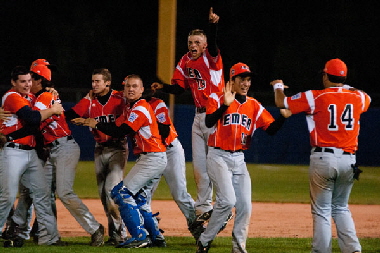 Although Friuli Venezia Giulia became only the second team to lose a semifinal via the 10-run rule (York County L.L., Yorktown, Va., was the first, in 2006, losing to eventual champ Paraguana L.L., Falcon, Venezuela), its run through the 2011 series was nonetheless memorable, as the Italians became the first Europe-Middle East-Africa team ever to reach the Senior League World Series semifinals. Although Friuli Venezia Giulia became only the second team to lose a semifinal via the 10-run rule (York County L.L., Yorktown, Va., was the first, in 2006, losing to eventual champ Paraguana L.L., Falcon, Venezuela), its run through the 2011 series was nonetheless memorable, as the Italians became the first Europe-Middle East-Africa team ever to reach the Senior League World Series semifinals.
After losing to Rose Capital East 11-2 on opening day, the Italians took a 5-0 lead over host Maine District 3’s Brewer/Orrington L.L., Brewer, fell behind 6-4 in the top of the sixth, and came back to win in the bottom of the seventh on a two-out, walk-off double by Alessandro Tonzar.
After their next scheduled game, against Canada’s Notre-Dame-de-Grace L.L., Montreal, Quebec, was rained out, the Italians found themselves having to win two games on the last day of pool play. That’s because the Europe-Middle East-Africa champs didn’t want to miss an opportunity of a lifetime on their scheduled off-day: a trip to Boston’s fabled Fenway Park to meet the Tampa Bay Rays, who were visiting the Red Sox. The trip to Fenway was compliments of coach Marcello Massa’s friendship with Rays pitching coach Jim Hickey.
Italy traveled 240 miles south to Boston on the morning of Aug. 17, watched the Rays beat the Sox 4-0 in an afternoon game, and traveled 240 miles back to Bangor, slept, then showed up at Mansfield Stadium early in the morning for the 9 a.m. game against the Canadians, whom they beat 13-7.
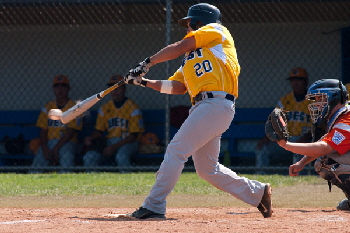 The Italians then had to wait all day before playing U.S. East champ Easton/Home Run Baker L.L., Talbot County, Md., in the 8 p.m. game to see who would win second place in Pool A and advance to the semifinals, as both teams entered the last game of pool play with a 2-1 record. The Italians then had to wait all day before playing U.S. East champ Easton/Home Run Baker L.L., Talbot County, Md., in the 8 p.m. game to see who would win second place in Pool A and advance to the semifinals, as both teams entered the last game of pool play with a 2-1 record.
The long break between games didn’t bother Italy, as it scored eight runs in the top of the third inning to take an 8-0 lead. But Easton/Home Run Baker came back with five runs in the bottom of the inning to make it 8-5.
The 9-8 win for Italy showed that baseball was slowly making an impact in soccer-rich Europe; maybe more so in Italy, which had now won the last four Europe-Middle East-Africa titles (including this year’s Emilia L.L., Emilia, Italy), with Friuli Venezia Giulia making two of those trips, the other coming in 2009.
For defending World Series champ Aruba South L.L., San Nicolas, Aruba, the 2011 series showed just how difficult it is to repeat as world champion. No Senior League Baseball champ has repeated since Chinese-Taipei won four straight titles from 1989 through 1992. In Bangor World Series, 2002 champ Pabao L.L., Willemstad, Curacao, Netherlands Antilles, fell in the 2003 semifinals to eventual champ Hilo; 2004 champ Freehold Township L.L., Freehold Township, N.J., fell in the 2005 semifinals to eventual champ Urbandale L.L., Urbandale, Iowa; 2006 champ Paraguana L.L., Falcon, Venezuela, lost the 2007 title game to Cartersville L.L., Cartersville, Ga; and 2009 champ West University L.L., Houston, Texas, didn’t even make it out of pool play in 2010.
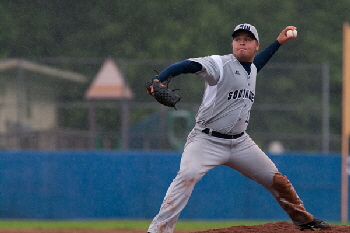 Aruba South had the misfortune of missing out on the top seed in Pool B when it lost 4-3 to Hilo on the second day of pool play in what many thought was the best played game in the series and a prelude to a rematch in the title game. Against U.S. West teams, Latin America teams are 3-5 (.375). Aruba South had the misfortune of missing out on the top seed in Pool B when it lost 4-3 to Hilo on the second day of pool play in what many thought was the best played game in the series and a prelude to a rematch in the title game. Against U.S. West teams, Latin America teams are 3-5 (.375).
Aruba South’s 10-5 loss in the semifinals to Rose Capital East shouldn’t have been all that surprising, considering that U.S. Southwest teams are 6-3 (.667) against Latin America teams. U.S. West and U.S. Southwest are the only regions with winning records against Latin America.
Friuli Venezia Giulia ’s surprising run to the semifinals marked the fourth straight series an underdog has reached the championship round.
In 2008, Canada reached the semifinals for the first time, with Whalley L.L., Surrey, British Columbia, losing 1-0 to eventual series champ North Cumberland L.L., Upper Deerfield, N.J. In 2009, Asia-Pacific took its turn in the semifinals when Illam Central L.L., Makati City, Philippines, went from 0-4 in the 2008 series to 3-1 in the 2009 series before losing to eventual series champ West University, 6-1 – most of the difference being a grand slam by Michael Resnick.
And, of course, there was 2010’s magical run by Maine District 3’s Bangor East/West L.L., Bangor, which made it all of the way to the championship game, losing 8-1 to Aruba South after being down only 3-1 entering the seventh inning.
Canada’s overall record before the 2008 series was 9-15 (.375). Asia-Pacific’s record before the 2009 series was 7-21 (.250). Maine District 3’s record before the 2010 series was 6-26 (.188).
Before this year’s series, Europe-Middle East-Africa’s record was 6-30 (.167).
 But although the cellar dwellers have all finally appeared in the semifinals, they haven’t fared so well since. Canada hasn’t won a game since 2008, going 0-12 in pool play. Asia-Pacific hasn’t won a game since 2009, going 0-8. Maine District 3 won only one game in last year’s series, faltering in its bid to pull out a win over Europe-Middle East-Africa and rallying too late in a 7-4 loss to Easton/Home Run Baker. But although the cellar dwellers have all finally appeared in the semifinals, they haven’t fared so well since. Canada hasn’t won a game since 2008, going 0-12 in pool play. Asia-Pacific hasn’t won a game since 2009, going 0-8. Maine District 3 won only one game in last year’s series, faltering in its bid to pull out a win over Europe-Middle East-Africa and rallying too late in a 7-4 loss to Easton/Home Run Baker.
Another curiosity is the U.S. Southeast region’s downswing in the last couple of years. Usually a strong contender, the region has gone 2-6 (.250) in the last two series with Palm Bay East L.L., Palm Bay, Fla., representing the region both times. Both wins have been over Asia-Pacific teams.
The U.S. Central region hasn’t had a team make the semifinals since 2005, when Urbandale L.L., Urbandale, Iowa, won that year’s series, going 3-1 in pool play and 5-1 overall.
No recap of the 2011 series would be complete without mentioning the Mansfield Stadium grounds crew. In the weeks leading up to each series, the grounds crew spends countless hours preparing both the field and the stadium grounds for the influx of fans and whatever bad weather nature has in store.
For only the second time in a Bangor series, two games were postponed on the same day. On Aug. 12, 2008, the first and last games of the day were postponed because of rain. Last year, Aug. 16 saw the last two games postponed because of rain.
It could have been worse on Aug. 16, as Easton/Home Run Baker and Rose Capital East were scheduled to begin the day’s first game at 10 a.m. But an all-night and morning rain pushed back the first pitch until 12:17 p.m. The two teams struggled through several delays as the grounds crew rushed to keep up with the constant rain. Water dripped from batters’ helmets, streams of water shot out from the indented end caps of the bats when batters swung, and when balls were hit, water – not dust – exploded from the cowhide.
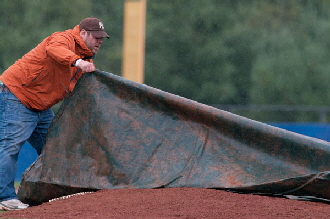 Only when the grounds crew realized it couldn’t spare any more Turface, the water absorbing material placed on the base paths, mound, and home plate area, did officials decided to stop play and send the teams back to the hotel for the longest rain delay in a Bangor World Series – some three hours. Only when the grounds crew realized it couldn’t spare any more Turface, the water absorbing material placed on the base paths, mound, and home plate area, did officials decided to stop play and send the teams back to the hotel for the longest rain delay in a Bangor World Series – some three hours.
During those three hours, the rain eventually subsided, the Mansfield Stadium’s drainage system did its work using crushed stone beneath the field and gravity to divert the water into drains, and the grounds crew was once again able to get the field ready, and Easton/Home Run Baker and Rose Capital East finished in sunlight.
|


















